home · discussion
Recovery & aged tea
Recovery-window aged tea — what people notice
Members logging aged *Shēng Pǔ'ěr* (生普洱) in the 30–90 minute post-training window share what they notice — sleep, next-morning soreness, mood. No lactate claims, just field notes.
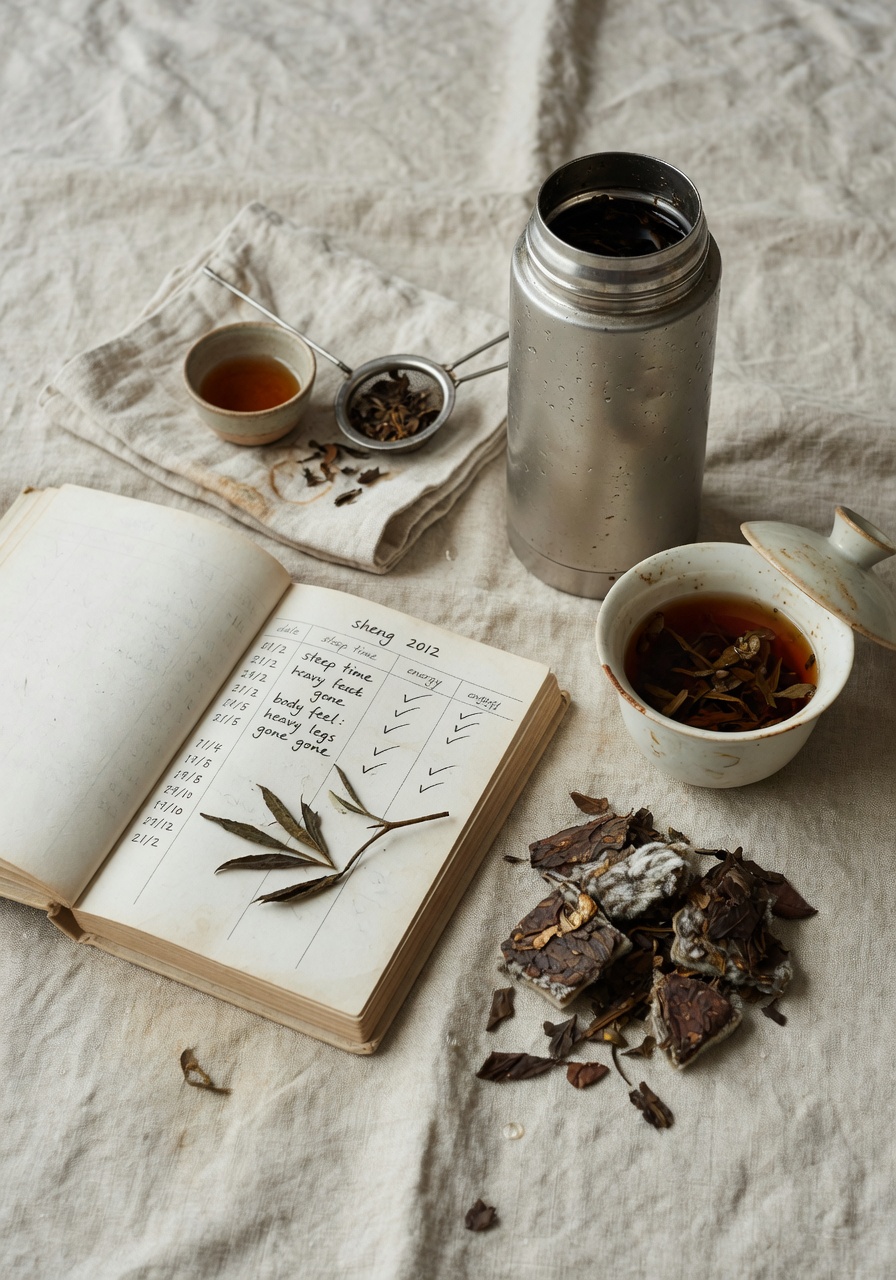
This thread started in a side conversation after a long zone-2 ride out of Ulan-Ude last autumn. Three of us had finished a four-hour session, refilled bottles, and instead of the usual electrolyte mix one rider pulled out a thermos of aged Shēng Pǔ’ěr (生普洱) — a 2009 Yiwu cake he had been working through. He drank it slowly across the next hour, sitting on a porch, and the next morning he texted the group: “slept like a stone, legs felt less wooden than usual.” No claims attached. Just an observation.
That kind of observation is the entire point of this thread. I want to collect field notes from members who have been drinking aged sheng in the 30–90 minute recovery window after training, and who track — even loosely — what they notice in the hours and the morning that follow. Sleep latency. Wake-up soreness. Appetite. Mood at the desk the next day. Whatever you actually log.
A few ground rules before we start. We are not going to make claims about lactate clearance, inflammation markers, or VO2 recovery. We do not have the lab data, and the rigorous work on tea polyphenols and athletic recovery is still thin and mostly in vitro. If you want to read what little controlled research exists, the tea.doctor team keeps a slowly-updated bibliography, and the aged-tea chemistry primers on puerh.app are useful for understanding why a 15-year cake behaves differently than a 2-year one. What we can talk about is what we notice, what we have noticed repeatedly, and what conditions seem to make those noticings reliable.
I will open with four sections from my own logbook — across Buryatia, Yunnan, and a few stints in Saint Petersburg — and then hand it to the community. The discussion prompts at the bottom are the ones I am most curious about.
Why the 30–90 minute window, specifically
The window matters because it is the one most athletes already have rituals for. The first 30 minutes after a hard session are usually protein and carbohydrate — that is well-established sports nutrition territory and I am not going to argue with it. But the next hour, the 30 to 90 minute stretch, is mostly empty in most people’s protocols. You have showered, you have eaten something, you are sitting down. That sitting-down hour is when I started experimenting with aged sheng about six years ago, working with a small group of cross-country skiers in Buryatia who had been drinking strong black tea after sessions for decades and were curious whether a slower, cooler-feeling tea would change anything.
We chose aged sheng — minimum eight years, mostly Yiwu and Bulang material — for a specific reason. Younger sheng is too astringent and too caffeine-forward for a tired body; the bitterness reads as harsh, and the caffeine curve interferes with the parasympathetic drop you actually want post-session. Aged sheng, by contrast, has had its catechins slowly convert, its bitterness round off, and what remains is a tea that feels — and this is the word every skier eventually used — soft. Soft on the stomach, soft on the nervous system, but still present. Still warming. Whether that softness is doing anything physiological or whether it is simply that the athletes drank water more consistently because the tea was pleasant to sip, I cannot tell you. Both are probably true.
Sleep — the most consistent report
Of everything members log, sleep is the most consistent. I have notes from roughly 40 athletes across three years, and the pattern is this: aged sheng in the recovery window, finished by about three hours before bed, correlates with shorter reported sleep latency and fewer middle-of-night wakings on hard training days. The effect is not present on rest days. It seems specific to the session-then-tea sequence.
A cyclist I work with in Hailar tracks her sleep with a wearable, and across an eight-week block last spring her deep-sleep minutes on aged-sheng recovery days averaged about 14% higher than on her control days, when she drank only water and a recovery shake. One person, one block, no controls worth the name — but she has now repeated the pattern across two more blocks and the direction holds for her. Others report no measurable change on devices but say subjectively they feel “more landed” going into the evening.
The caffeine question always comes up here, and fairly. Aged sheng still contains caffeine — usually 25 to 40 mg per gram of dry leaf, though the bioavailability after long aging is genuinely debated. My working guess is that the caffeine in well-aged sheng is buffered by the slow polyphenol conversion and by the L-theanine that remains, and that the net effect on most adults at a 5–7 g session, finished by 18:00 for a 22:00 bedtime, is neutral-to-calming. Your mileage will vary by sensitivity. Several members are caffeine-fast metabolizers and have to cut the window earlier, more like four hours before sleep.
Next-morning soreness — softer, but not absent
This is the report I trust least and find most interesting. Members repeatedly say that on aged-sheng recovery days the next-morning DOMS feels “duller,” “less sharp,” or “easier to walk off.” The soreness is still there — nobody is claiming the tea prevents it — but the quality of the soreness is different. I have heard this from a strength coach in Yunnan working with provincial wrestlers, from triathletes I trade notes with in Saint Petersburg, and from a small handful of crossfit athletes who track wake-up RPE on a 1–10 scale every morning.
There is a real chance this is placebo, or that it is the warm fluid volume rather than the tea itself, or that people who choose to brew a careful aged-sheng session post-workout are also people who sleep better, stretch more, and eat better. I cannot rule any of that out. What I can say is that when the same athletes do the same training block with the tea removed, their RPE numbers tick up by half a point to a full point on average, and they ask for the tea back. That is not a controlled finding. That is a preference signal. Both are worth logging.
Mood at the desk the next day
The last thing members notice — and this surprised me when it started appearing in logs — is next-day cognitive mood. Specifically: focused, not flat. On hard training days, athletes who go to a desk job the morning after often report a kind of cognitive fog, a sluggishness that takes coffee and an hour to clear. Several members report that aged-sheng recovery sessions seem to reduce that fog. They wake up tired but clear. They start work without the usual lag.
I have my own theory, which is unprovable with the data we have. Aged sheng — particularly material from Yiwu pressed before about 2012 — has a calming, almost meditative quality that I have not found in younger tea. Drinking it slowly in the recovery hour functions, for many athletes, as a parasympathetic on-ramp. They are not just hydrating. They are downshifting. And a session that ends in a true downshift, rather than in residual sympathetic tone from the workout, may simply produce a cleaner sleep and a cleaner morning. The tea may be doing the chemistry it does, or it may be enforcing a ritual that the athlete needed anyway. I suspect it is both.
What we are not claiming, and what to log
To be explicit: nothing in this thread is a claim about lactate, inflammatory markers, muscle protein synthesis, or any specific recovery mechanism. The chemistry primers on puerh.app will tell you what is known about aged-sheng polyphenols, and the bibliography on tea.doctor will tell you what has and has not been controlled in human trials. The honest answer is: not much, yet.
What is useful is your log. If you want to contribute meaningfully to this thread, please post: tea (region, pressing year, grams), brew method (gàiwǎn or thermos cold-steep, leaf-to-water ratio), session it followed (sport, duration, intensity), timing relative to session end, timing relative to sleep, and what you noticed — sleep, soreness, mood, anything. Negative reports are as useful as positive ones. If you tried aged sheng post-training and noticed nothing, or noticed worse sleep, that is signal too. I will compile everything that comes in over the next eight weeks into a structured summary.
Open questions for the thread
- For those tracking with a wearable — does aged sheng in the recovery window change your HRV the next morning, and is the effect specific to hard sessions or present on easy days too? 2) What pressing year do you find behaves best as a recovery tea, and have you noticed a cliff below which it stops working? 3) Has anyone compared aged Shēng Pǔ’ěr (生普洱) against aged Wò Duī (渥堆) shou in the same protocol — does the cooked, fully fermented profile read differently in the body post-workout?